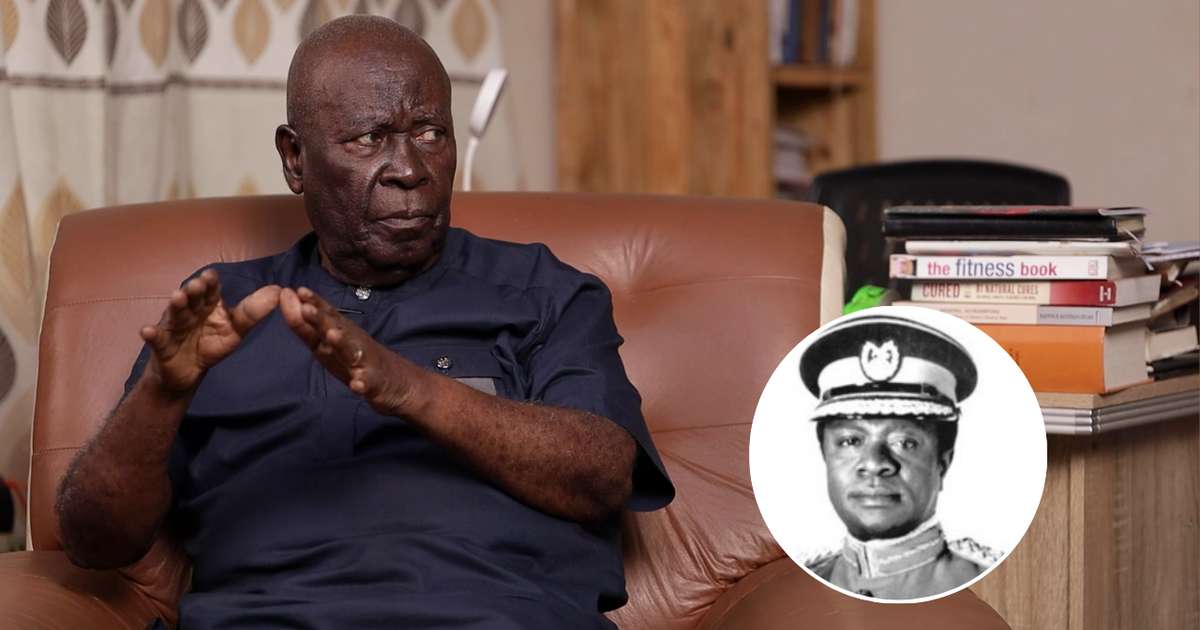
For Major Patrick Adjei-Ampofo, the economic story of the Acheampong era cannot be told simply as a catalogue of failures.
Decades after the overthrow of Ghana’s military government, Major Adjei-Ampofo is offering a different account of the period one in which an unpopular regime, in his view, also pursued policies that captured the imagination of ordinary Ghanaians and channelled scarce resources into development.
At the centre of his defence is a campaign whose name remains etched in Ghana’s political and economic history: Operation Feed Yourself.
According to Major Adjei-Ampofo, the programme succeeded because its objective was straightforward, get Ghanaians to produce more of what they consumed.
“It succeeded because the objective was good,” he said in an interview with Kafui Dey.
But for Major Adjei-Ampofo, the success of the programme was not merely something measured in government reports.
It could be seen right in people’s homes.
The campaign became so popular, he recalled, that ordinary Ghanaians began turning even the small spaces around their houses into vegetable gardens.
“It aligned with the sentiments of the university graduates, and everybody. It became so popular that even in the front gardens of people, they were growing vegetables.”
The programme, he argues, went beyond encouraging household farming. Ghana, he says, was producing enough to support exports.
“We had a lot of fish in the sea, and the operation was so successful we were even exporting rice.”
For Major Adjei-Ampofo, that period demonstrated what could happen when national policy connected with the everyday needs and aspirations of citizens.
But his defence of the Acheampong administration does not stop at agriculture.
He also revisits one of the most controversial economic decisions of the era: Ghana’s decision to delay repayment of its international debts.
For critics, the move could be viewed as a sign of financial indiscipline. Major Adjei-Ampofo, however, offers a different explanation.
He says the decision was essentially about creating breathing room for the government to pursue development projects at a time when resources were limited.
“That was the commissioner’s idea,” he explained.
According to Major Adjei-Ampofo, the government faced a difficult choice: use scarce resources to service debt or redirect some of those resources towards projects it believed were necessary for Ghana’s development.
“He couldn’t clear the debt and look at his own projects at the same time. So he did it just to delay the payment.”
In Major Adjei-Ampofo’s telling, the debt delay was therefore not simply about refusing to pay.
It was about buying time.
“It allowed him to have resources, to have some breathing room.”
And, he argues, that breathing room translated into visible development.
Major Adjei-Ampofo points to road construction and other infrastructure projects, including the Tema-Akosombo road network, housing projects in Kumasi and rural roads.
He also recalls investment in education and government support for Ghanaian-owned businesses, including Kussi Motors and Tata Brewery.
To him, these initiatives form part of an economic record that he believes has often been overshadowed by the controversies surrounding the Acheampong regime.
His defence is also deeply personal.
Speaking about General Ignatius Kutu Acheampong, Ampofo does not sound like a man discussing a distant historical figure. Instead, there is a sense of disappointment that the man he knew has, in his view, been remembered largely through the failures and controversies of his administration.
“He did a lot of good things,” Major Adjei-Ampofo said.
Then came the more personal verdict.
“A lot of the things they said about him, it pained me, because he was a good man.”
Major Ampofo believes Acheampong’s intentions were not necessarily the problem.
Rather, he argues, the former military leader had a weakness that others exploited.
“He had a good heart, but people exploited his weakness.”