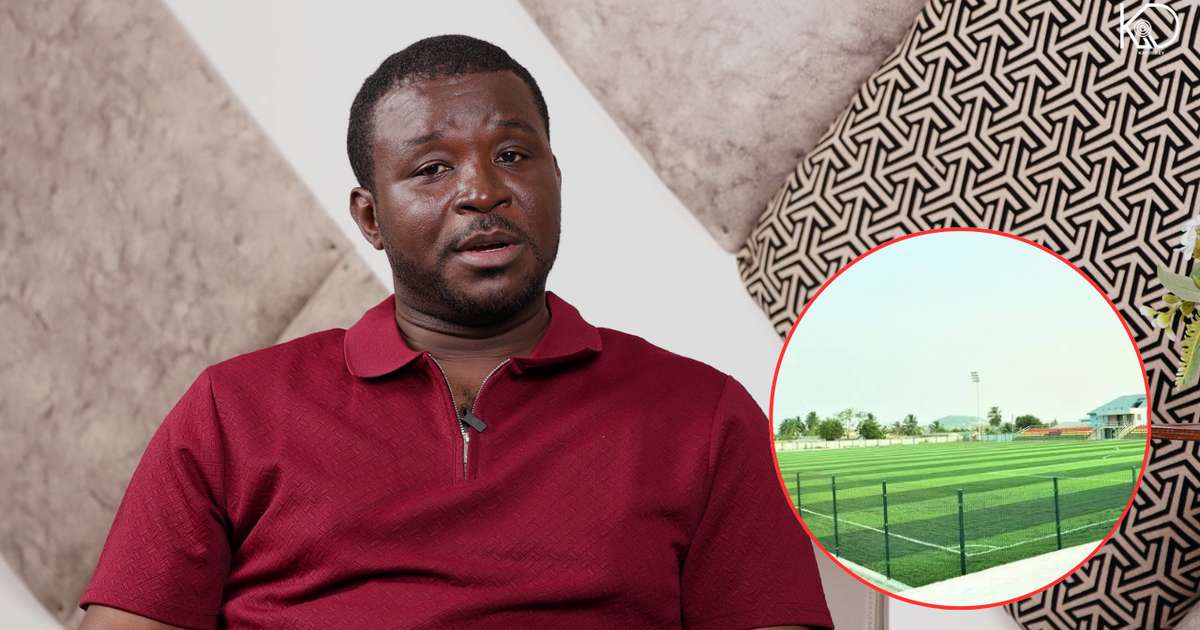
“If you want to fix Ghana football, stop looking at the Premier League.”It wasn’t a throwaway line. It was a diagnosis.
For more than four hours on Kafui Dey’s podcast , sports journalist Godfred Akoto Boafo dissected the state of Ghanaian sport with the precision of a surgeon. By the time the conversation reached football, he had already spoken about the decline of boxing, the struggles of tennis, the cost of developing swimmers and the economics shaping African sport.
But when the spotlight turned to Ghana football, his verdict was blunt: the problem isn’t just on the pitch, it’s in the entire system.
One of the interview’s most startling revelations came when Akoto Boafo made a claim that challenges conventional wisdom.
“The best talents in Ghana football don’t play in the Ghana Premier League. They play in Division Two. They play in Division Three.”
It sounds unbelievable until he explains why.
According to him, international scouts rarely spend their time watching Premier League matches in Ghana. Instead, they head to dusty community parks and lower-division games, where raw talent is still being developed before it is polished or exported.
“There’s a reason why the technical directors of the biggest clubs in the world fly into Ghana and you never meet them at Premier League matches,” he said. “You’ll find them on the sandy pitches in places like Darkuman and Dzorwulu.”
For him, Ghana’s football future is being built far away from the bright lights.
Perhaps even more surprising was his personal confession.
“I’ve stopped watching the Ghana Premier League.”
Not because he doesn’t love Ghana football. Quite the opposite.
Akoto Boafo has commentated on the domestic league and witnessed what many consider its golden era. But today’s product, he says, no longer excites him.
“I spend my time watching Division Two and Division Three.”
Why? Kafui Dey asked
Because that’s where he believes the country’s future stars are playing.
If administrators are wondering why excitement around the domestic league has faded, Akoto Boafo believes supporters have already answered.
“They voted with their feet.”
He pointed to average attendances of around 1,000 spectators per match last season, a figure he says tells its own story.
Even the once-famous Hearts of Oak versus Asante Kotoko rivalry no longer carries the same magic.
“What’s the storyline?” he asked.
According to him, the biggest clubs no longer have the country’s best players, making the spectacle less compelling than it once was.
For Akoto Boafo, rebuilding Ghana football isn’t only about tactics or coaching.
It’s about creating clubs that operate like modern businesses.
He singled out Medeama SC as an example of a club moving in the right direction.
“They have in-house media, their own TV platform, a podcast and a well-run social media team.”
They also recruit players people actually want to watch.
One of his boldest proposals concerns infrastructure.
He believes Ghana’s traditional giants should stop relying on the national stadium for every home game.
Instead, clubs like Hearts of Oak and Asante Kotoko should own or operate modern stadiums of around 10,000 seats, using larger national venues only for blockbuster fixtures.
He points to successful African clubs like Mamelodi Sundowns and Orlando Pirates, who maximise revenue by playing most matches in smaller, more manageable stadiums before moving marquee games to larger arenas.
“It’s about making sense of costs,” he explained.
Without that kind of planning, clubs continue losing money while fans lose interest.
Not everything, however, is moving backwards.
Akoto Boafo praised the Ghana Football Association for the progress made in women’s football.
Much of that, he noted, has been driven by FIFA’s investment in the women’s game.
“We’ve seen significant improvement.”
His hope is that the same level of organisation and long-term planning eventually reaches the men’s game as well.
Better Stadiums, Better Football
When Kafui Dey asked about crowd violence, Akoto Boafo didn’t begin by talking about policing.
He started with stadium design.
According to him, modern infrastructure naturally limits disorder while making it easier for security personnel to respond when incidents occur.
Asked to name the best stadium he has visited, he praised Morocco’s Mohammed V Stadium, describing it as “the kind of stadium you’d expect Real Madrid or Barcelona to play in.”
He also marvelled at Atlanta’s Mercedes-Benz Stadium in the United States.
“As soon as you cross the turnstiles, you’re in air conditioning,” he said with a smile.
For him, infrastructure isn’t a luxury.
It’s part of the football experience.
Football Starts Long Before the Premier League
As the conversation unfolded, one theme kept resurfacing.
Whether discussing boxing, swimming, tennis or football, Akoto Boafo always returned to the same principle: success is built at the base.
The grassroots matter.
Facilities matter.
Coaching matters.
Investment matters.
By the end of the interview, it became clear that his blueprint for fixing Ghana football isn’t complicated, it just requires patience, planning and the willingness to invest where it matters most.
The next Black Stars captain, he believes, is probably not playing in a packed stadium today. He’s likely on a dusty community pitch, waiting for someone to notice him.