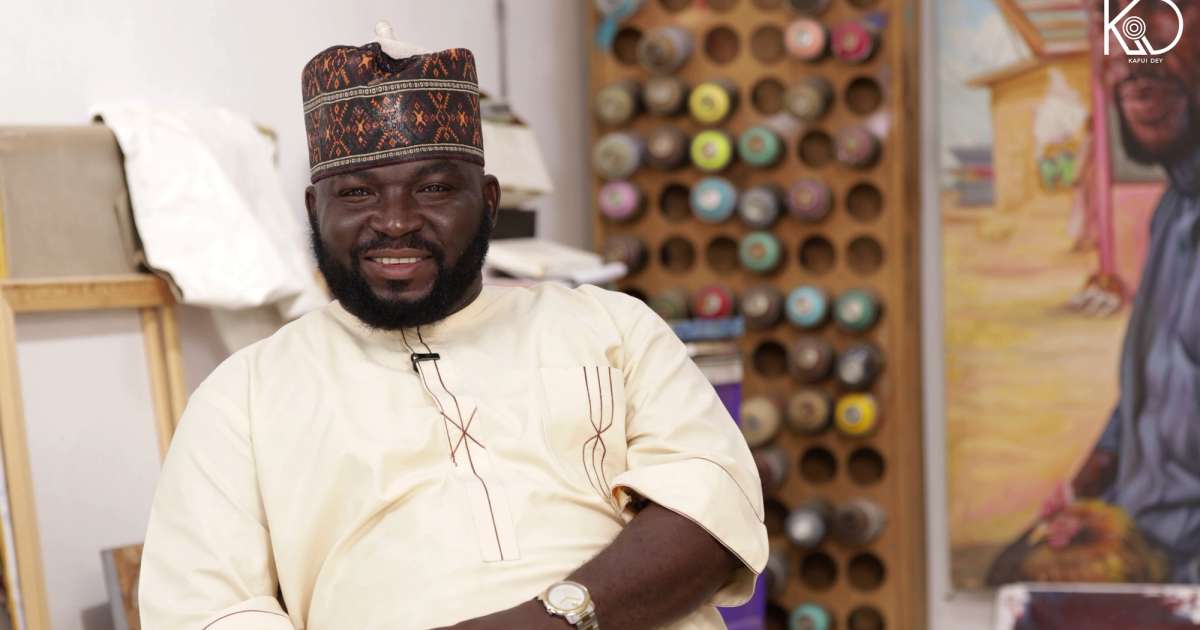
Every year, invitations arrive from different parts of the world asking Moh Awudu to tell Ghana’s story through his art. For years, the Ghanaian artist has travelled beyond the country’s borders, using paintings as a language of culture, history and identity. His work has taken him across continents, where he has represented Ghana at exhibitions and cultural exchanges, often at the invitation of foreign institutions and governments.
But while the world has opened its doors to his art, Moh Awudu says the country whose story he tells has never invested in his journey.
Speaking on Kafui Dey’s podcast, the artist revealed that despite years of promoting Ghana internationally, he has never received public funding to support his work.
“Never,” he said when asked if he had ever benefited from government funding for his artistic projects.
For Moh Awudu, the challenge facing many Ghanaian creatives is not a lack of talent, but the absence of a functioning support system that allows artists to grow and contribute meaningfully to national development.
“I think working here in Ghana, how to even get funds is hard,” he said. “Are there funds available where you can apply to get some money and do some work? No, you don’t.”
His frustration comes from years of experience navigating the creative industry both locally and internationally. He believes many countries understand that artists are cultural ambassadors and have created systems to support them. His own story, he argues, is evidence of that difference.
For close to a decade, Moh Awudu says he has received invitations from countries including Brazil and Senegal to represent Ghana through his art.
“These are governments of those countries,” he explained, describing the invitations as part of cultural exchange programmes.
To him, art provides a unique way for nations to preserve and communicate their histories. A painting, he believes, can sometimes tell a country’s story in ways words cannot.
“If they want to talk about Kwame Nkrumah, they cannot express Kwame Nkrumah well without a Ghanaian doing it,” he said.
Yet, he says, his attempts to seek support from Ghanaian institutions have often produced silence. He has reached out to organizations responsible for tourism and creative arts, hoping to find partnerships that would enable him to continue representing Ghana internationally. According to him, many of those efforts have gone unanswered.
“Sometimes it’s hard for us,” he said, adding that institutions sometimes share and promote the works of Ghanaian creatives online without directly supporting the people behind them.
For the artist, the problem is not the absence of offices or structures. It is the gap between having institutions and making them work effectively.
“I feel like we have the offices, the structures are there, but the system is not working,” he added.
He believes Ghana needs a transparent creative funding system where artists with meaningful projects can access support through proper applications and proposals.
“Every country, they give funding for artists,” he said. “If somebody brings a proper proposal of a project or an artist needs funding, they support them.”
Remembering an era of cultural investment
Moh Awudu believes Ghana once had a stronger appreciation for the role of culture in shaping national identity. He points to the era of Kwame Nkrumah, arguing that arts, music, drumming and dance received greater attention as tools for promoting Ghana’s image.
“I think this era we are losing patriotism,” he said. “The system is killing people’s patriotism.”
According to him, the vision of leaders is sometimes weakened by the people responsible for implementing policies.
“Sometimes the presidents have their mind on that, but the people who are working for them; the ministers, the directors — they are the ones who don’t,” he said.
He also recalled instances where international support meant for creatives did not appear to reach many artists who needed it.
“Some creatives have it; those who are close,” he said, suggesting that access to opportunities is sometimes influenced by connections rather than merit.
The cost of carrying Ghana’s name
Despite his disappointment, Moh Awudu says his commitment to Ghana remains unchanged. His paintings continue to tell stories about the country, its history and its people. But he admits that years of giving without receiving support have changed how he views his relationship with the state.
“I think I sacrifice for this country more than what the country is giving us,” he said.
He recalled a time when he questioned whether people who complained about a lack of support were doing enough for their country. But his own journey taught him that patriotism can sometimes come with personal sacrifices.
“Sometimes when you open your heart and you want to sacrifice for the country, you are the one who is going to be really cut out,” he said.
For now, Moh Awudu continues to carry Ghana’s story across borders, supported by his passion, his talent and international recognition.
But he hopes that one day, Ghana will build a system that recognizes artists not only as creators, but as ambassadors whose work helps shape how the world sees the nation.