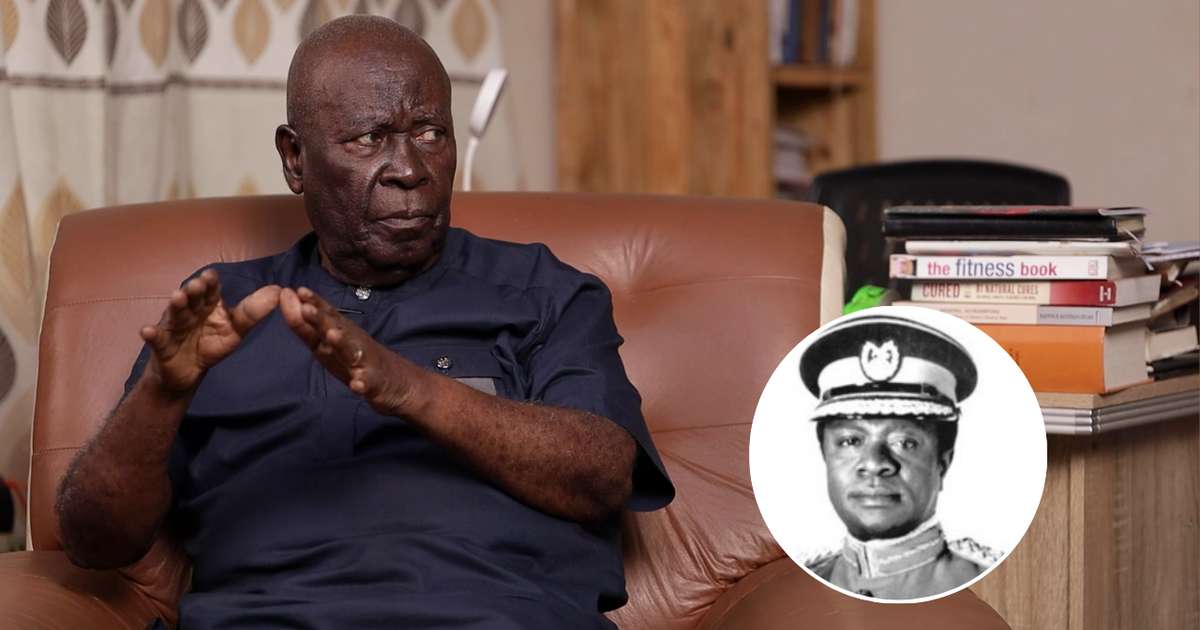
For weeks, something was changing inside Ghana’s military leadership.The conversations were quieter. The loyalties were shifting. And behind the formal meetings and official duties, a dangerous question was taking shape:* How do you remove the man at the top?*
Major Adjei Ampofo was close enough to General Ignatius Kutu Acheampong to sense that something was wrong.
He knew some officers were turning against the Head of State. What he did not know was just how far the plot had gone or that his own colleagues had deliberately kept him out of it.
“They knew I would stop them,” Major Adjei Ampofo recalled in an interview with Kafui Dey.
That decision to exclude him would later place him in one of the strangest positions of the July 1978 change of government: close to the centre of power, yet deliberately kept away from the operation that would end Acheampong’s rule.
By then, the tension within the military was no longer invisible.
“We knew very much,” Major Adjei -Ampofo said, recalling how officers were increasingly turning against General Acheampong.
Even General Acheampong appeared to understand the danger surrounding him.
At one of his weekly meetings with his ministers, Major Adjei -Ampofo recalled the General issuing a chilling warning.
“If you give me up, I know I’ll be killed but so will all of you,” General Acheampong reportedly told them.
It was a warning that would prove painfully prophetic.The plan to remove him was already taking shape.
According to Major Adjei-Ampofo, the original plan was designed around a meeting that was expected to bring the opposing officers into one place.
Acheampong was supposed to remain at home while loyalists prepared to arrest those suspected of plotting against him.
But the plan did not unfold as expected.
General Acheampong went to the Ministry of Defence.
Major Adjei Ampofo was not with him.
And inside the Ministry, the balance of power suddenly shifted.
Instead of his loyalists arresting the plotters, General Acheampong found himself confronted by officers demanding that he resign.
“They forced him to sign the declaration,” Major Adjei Ampofo recalled.
General Acheampong, he said, initially asked for time.
“He said, ‘Okay, give me a couple of minutes to think it over.’”
But the decision had already been made.
On 5 July 1978, General Acheampong was removed as Head of State and replaced by General Fred Akuffo, who was Acheampong’s deputy and the Chief of Defence Staff
While the military leadership was changing at the Ministry of Defence, Major Adjei Ampofo was at Job 600, keeping out of sight.
His own life, he said, was considered to be at risk. He eventually returned home only to discover that something extraordinary had happened.
Crowds had gathered outside General Acheampong’s residence.
The General was gone.
The government had changed.
And Major Adjei Ampofo wanted answers.
He did not wait for an appointment.
He went straight to the new Head of State.
“I went past his ADC, I went past his enemy’s office, and I went straight into his office,” he recalled.
Inside, General Fred Akuffo was meeting with the Governor of the Bank of Ghana and the Chief Justice.
The sudden appearance of Major Adjei Ampofo caught him off guard.
“He was startled when I entered the room,” Major Adjei Ampofo said.
But for him, walking into that room was more than an act of defiance.
It was a moment when he believed his position and courage came from somewhere beyond himself.
“Look when God gives you a job to do, he gives you power,” he said.
Almost a year later, Ghana’s military would be shaken by another uprising led by Flight Lieutenant Jerry John Rawlings and the Armed Forces Revolutionary Council (AFRC). One that would lead to the executions of senior officers, including the man Major Adjei Ampofo had served.
This time, there was no palace intrigue to observe from a distance.
There were cells.
There were footsteps.
And there were names being called in the darkness.
When Major Adjei Ampofo learned that Acheampong had been executed following the 4 June 1979 uprising, he said he was devastated.
“I felt sad. I felt very, very sad,” he recalled.
But beneath the sadness was a grim certainty.
“But I knew it was coming. I knew he would be killed.”
Major Adjei Ampofo said Acheampong himself appeared to have understood that his fate was sealed.
According to his recollection, when people offered the former Head of State an opportunity to escape, Acheampong refused.
“When people offered him to run away, he said, ‘No, let them come for me.’”