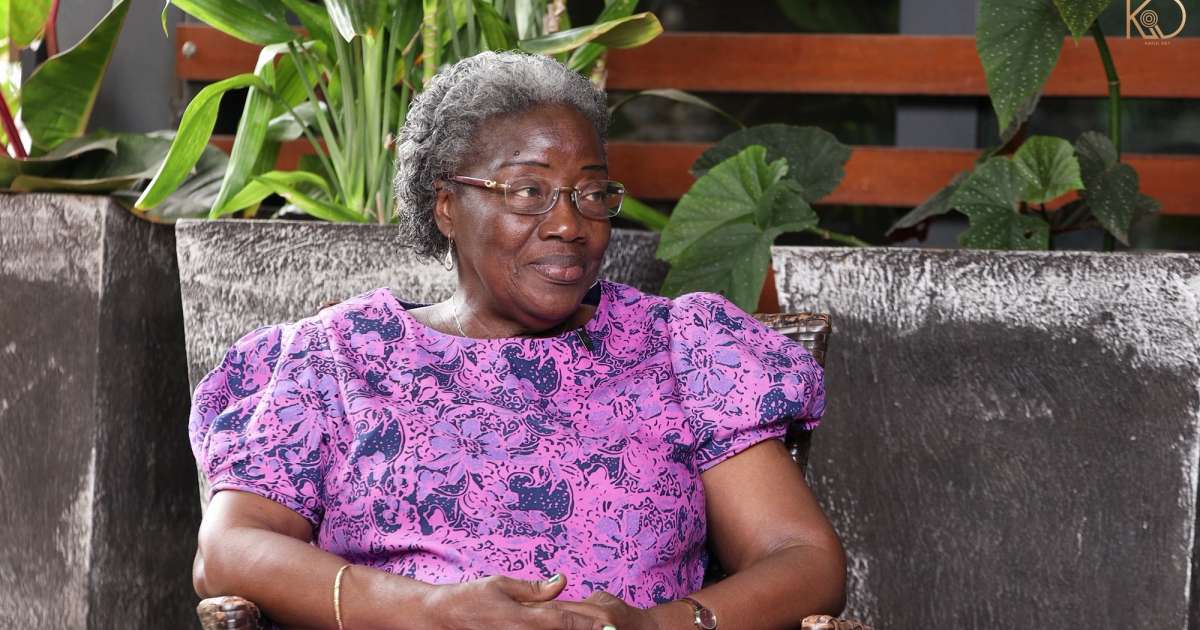
Wife of former Vice President of Ghana, Matilda Amissah-Arthur wants Ghanaians to stop hiding behind euphemisms when someone dies. For her, words matter.
And when it comes to death, she believes people should call it exactly what it is.
“My husband died,” she said.
Mrs Amissah-Arthur explained that she deliberately avoided the popular expression that someone has “passed away” or that a person has been “lost”.
“I don’t like ‘I lost my husband.’ I didn’t lose my husband. My husband died.”
For years, Ghanaians have used expressions such as “I lost my husband”, “he has passed” or “the late” to talk about someone who has died.
Mrs Amissah-Arthur believes those expressions can sometimes prevent people from properly confronting their grief.
Her preferred words are much simpler.
“My husband died.”
She made the point during her conversation with Kafui Dey, explaining that she deliberately refused to describe her husband’s death as a loss.
“I don’t like ‘I lost my husband.’ I didn’t lose my husband. My husband died.”
The distinction may sound small, but for her it is important.
She even wanted to call her book about her experience My Husband Died.
Her publisher, however, advised against it.
“It was my publisher who said, ‘I beg you Ghana, if we write my husband died, nobody will buy your book. So change the title.’”
But she did not abandon the message.
She said the opening pages of the book contain a poem making the point she wanted readers to understand.
“ I didn’t lose my husband. He died. That’s it.”
She has a similar problem with the expression “the late”.
“The one I hate is ‘the late’. He’s late. I said, ‘He’s late to where?’”
For her, death should not be treated as something too frightening to name.
She believes families sometimes make grief harder by refusing even to mention the name of the person who has died.
“Mention his name. Mention her name. Talk about it.”
According to her, avoiding the subject can leave people struggling to process what has happened.
“You won’t deal with the grief.”
She says the issue is particularly important in Ghanaian society because death is often surrounded by mystery and fear.
“When you are bereaved you are vulnerable,” she explained in discussing the period immediately following someone’s death.
That vulnerability, she said, can make people susceptible to pressure, bad advice and people who take advantage of their emotional state.
Her answer is not to avoid grief but to confront it.
For Mrs Amissah-Arthur, talking about someone who has died does not mean refusing to move on.
She herself still experiences moments when she walks into a room and wishes her husband were there.
But she has also learnt that moving forward is part of surviving the loss.
“You should move on.”
Eight years after her husband’s death, she says the pain and memories have not simply disappeared.
But she has learnt to live with them.
And perhaps that is why she insists on using the simplest words possible.
He did not get lost.
He died.