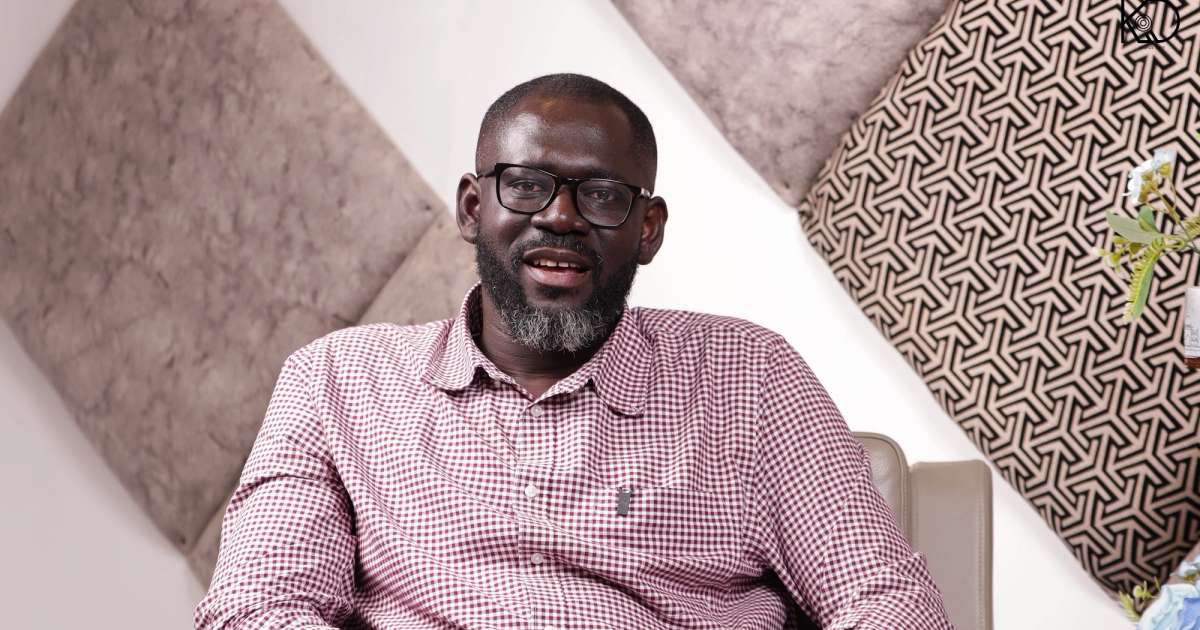
Ghanaian political economist, author, and academic, Dr. George Asiamah has opened up about one of the most painful moments of his academic journey; the day he received a Senior Secondary School Certificate Examination (SSSCE) result bearing four Fs and three Es.
Looking back at the result years later, Dr. Asiamah describes the experience with an unusual phrase: “I failed beautifully.”
His reflection came during an interview with broadcaster Kafui Dey, where he discussed his memoir, The Back Route: A Memoir of Delay, Discipline, and Becoming.
The memoir chronicles his academic journey, including the dramatic gap between his secondary school results in 2003 and the completion of his PhD in 2023; a 20-year journey that began with what appeared to be a devastating academic failure.
The academic who currently serves as a Fellow and Tutor in Politics at Exeter College, University of Oxford recalled that his July 2003 results showed Fs in Mathematics, English Language, Economics and Geography, while he obtained Es in Integrated Science, Social Studies and Government.
There were no Ds, Cs, Bs or As on the results slip.
“I only had F and Es. So no D, no C, nothing,” he recalled.
When Kafui Dey pointed out the unusual pattern of his grades, Dr. Asiamah responded with humour: “Ironically, it’s pronounced F-E-F-F-E-F-E” to wit beautiful in the Akan parlance
Then came the line that captures his attitude towards the painful chapter of his life.
“So I failed beautifully,” he said.
But behind the humour was a young man who had just experienced what he considered a crushing disappointment.
Dr. Asiamah said he already knew he was likely to fail the examination because he had become a truant during his final year.
As a day student and the only person from his village attending secondary school, he sometimes stayed home instead of making the roughly five-kilometre journey to school.
During the mock examination period, he said he would go to school only to write the papers and return home afterwards.
“I would just go, write, and come back. And then stay. I wouldn’t go to campus again until the next paper,” he recalled.
At home, he said, he was largely doing nothing.
“I was just back home playing. Just doing nothing, basically,” he said.
His reasoning at the time was that travelling to school during the mock examination period was a waste of time because there was little teaching taking place.
That decision, however, would eventually catch up with him.
Dr. Asiamah said he remembered the day his headmistress handed him his results slip. She looked at it but said nothing.
He opened it and was stunned.
Although he expected to fail, he had hoped to pick up a few Ds or Cs.
Instead, the slip contained four Fs and three Es.
“I was expecting to fail, but then not this failure,” he said.
The shock was so overwhelming that he described momentarily losing himself.
He then walked from the school at Kyireabom back to his village,Chichibon, but could barely remember the journey.
“I just folded it and put it somewhere. And to me at the time, that was it. It was over,” he said.
The result was particularly painful because of the expectations surrounding him.
At the time, Dr. Asiamah was regarded as a bright young man in his village. He had been the best candidate at the Junior Secondary School level, obtaining an aggregate 22.
He was also the only student from the village attending secondary school.
“For the village, they perceived me to be their bright candidate,” he said.
The contrast between that reputation and the SSSCE results made the failure even more difficult to accept.
But what appeared to be the end of his academic journey eventually became only one chapter in a much longer story.
Twenty years after obtaining the four Fs and three Es in 2003, Dr. Asiamah completed his PhD in 2023.
For him, The Back Route is therefore not simply a memoir about academic achievement. It is a reflection on delay, discipline, setbacks and the possibility of becoming something far beyond what an early failure may suggest.
And perhaps that is why, looking back at the result that once left him devastated, he can now say with a smile:“I failed beautifully.”