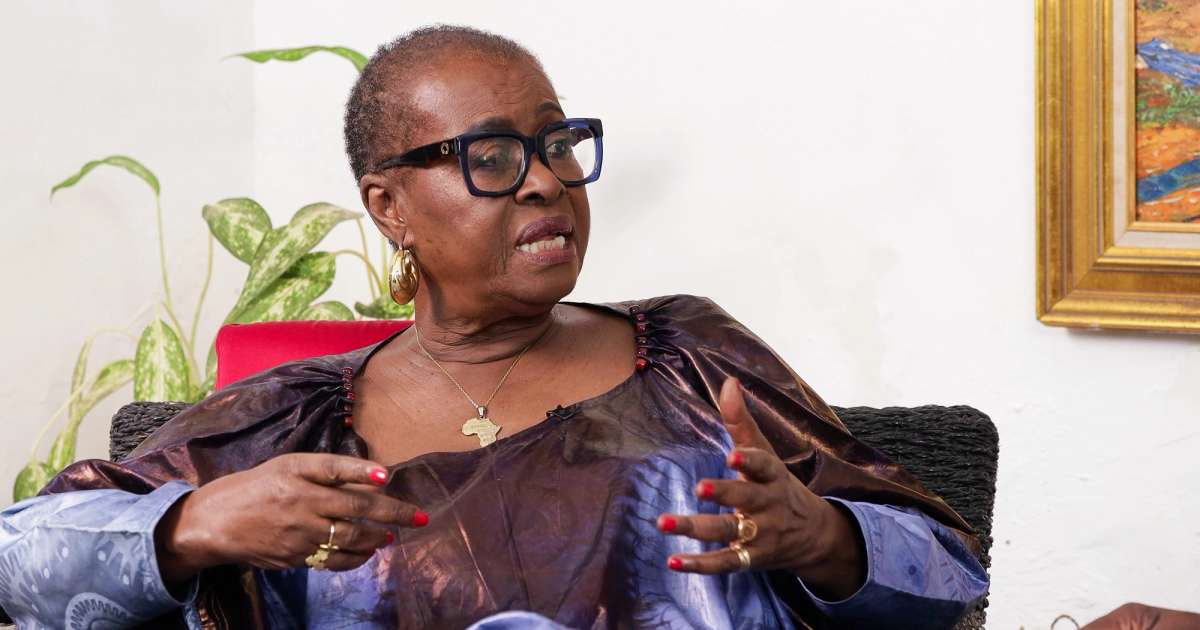
For legendary Liberian musician and broadcaster Miatta Fahnbulleh, the overthrow of Ghana’s first President, Dr. Kwame Nkrumah, was not just a political event. It was a deeply emotional moment that left an entire generation of young admirers across West Africa in tears.
Speaking in an interview with Kafui Dey, the renowned singer, songwriter, composer, producer and African music custodian recalled how February 24, 1966, became the first time she saw her father, Ambassador Fahnbulleh Senior, cry.
Her father, a Liberian diplomat and a devoted admirer of Nkrumah, was deeply shaken when news broke that Ghana’s first president had been removed from office through a military coup.
“1966, when Nkrumah was overthrown, that was the first time I saw my papa cry,” Miatta Fahnbulleh recounted.
She remembered her father returning home from work unusually quiet before retreating to his study, where he expressed his grief privately.
“He came home from work and was just quiet. He went to his study. It was his cry,” she said.
At the time, Fahnbulleh was a student in boarding school. She and her classmates were preparing to attend an event at the British Council when they received the news that Ghana’s president had been overthrown.
“We were all dressed and everything to go to the British Council, and then they came and said we are cancelling it. I asked what was happening, and they said Dr. Nkrumah has been overthrown,” she recalled.
The news triggered an emotional reaction among the young students.
“You should have heard us. Everybody started crying. Fifteen, sixteen-year-old girls were crying for Nkrumah,” she said.
While many Ghanaians poured into the streets to celebrate the end of Nkrumah’s government and the removal of his statue, Fahnbulleh said the reaction was completely different in Liberia and other parts of West Africa.
“The next day, when I heard that Ghanaians were celebrating and they had brought a statue down, I said, ‘What’s wrong with these Ghanaians?’” she said.
With a mixture of humour and reflection, she added: “Ghanaians, you were not our favourite people in 1966.”
For many admirers of Nkrumah outside Ghana, the coup represented a painful setback for Africa’s liberation dream. Fahnbulleh described the mood in Liberia and Sierra Leone as similar to a period of mourning.
“It was like a mourning period for us in Sierra Leone and Liberia,” she said.
Her family’s connection to Nkrumah went beyond admiration. After the coup, several supporters of Nkrumah’s government who went into exile found shelter in countries such as Guinea, Liberia and Kenya. As a diplomat, her father helped some of them when he was stationed in Nairobi.
But Ambassador Fahnbulleh Senior’s admiration for Nkrumah later became a source of trouble. In 1968, he was accused of treason by the Liberian government. Among the allegations was that he kept a portrait of Nkrumah in his home but did not have one of Liberia’s then President William Tubman.
“My father said, ‘The residence is my private property, my home,’” Fahnbulleh recalled.
She explained that Nkrumah’s picture was displayed in their house because of her father’s personal respect for him, while Tubman’s portrait was found in his official office.
The charges were serious. According to Fahnbulleh, the attorney general at the time said that if her father’s alleged plans had succeeded, he would have faced the death penalty. However, because the alleged plans failed, he was sentenced to 20 years in prison before later being pardoned by President William Tolbert.
Decades later, Fahnbulleh’s memories offer a reminder that Nkrumah’s influence extended far beyond Ghana’s borders. While his leadership remains debated within Ghana, his vision of African unity inspired deep loyalty among many across the continent.
For one young Liberian girl in a boarding school and her father, February 1966 was not a day of celebration, it was a day of tears.