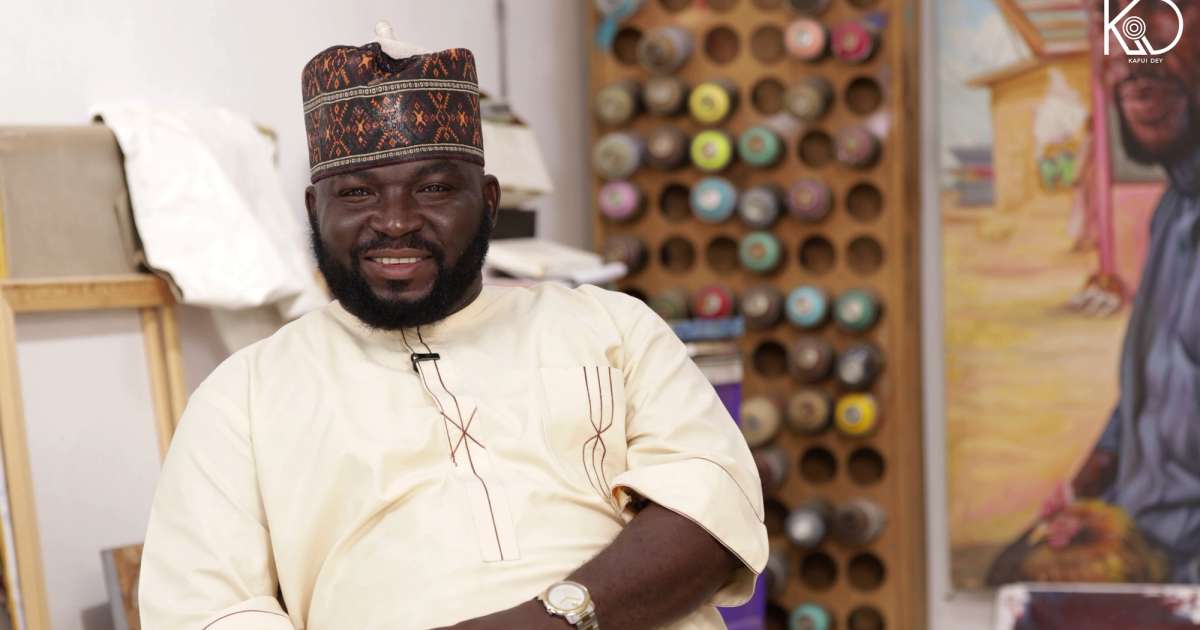
Moh Awudu has painted walls across continents, but one mural in rural Australia taught him that art can carry histories invisible to outsiders.
It was supposed to be another commission at the Sanaa Festival, where artists from across Africa had gathered to collaborate with local communities. Painters from Kenya, Uganda, Tanzania, Zambia, Senegal and Ghana had travelled thousands of kilometres to leave their mark on Australian walls.
For Awudu, however, one wall nearly became the centre of a conflict he never saw coming.
By the time he arrived in a quiet countryside town, most of the visiting artists had completed their murals and moved on. Awudu’s work was different. He had been selected to paint in multiple towns and collaborate with a respected Aboriginal artist whose knowledge of the land stretched far beyond paint and canvas.
Together, they surveyed the site. Awudu sketched his concept; an homage to Australia’s Indigenous people using an old Aboriginal photograph as inspiration.
It seemed like a fitting tribute. Then everything changed.
As he worked, his Aboriginal collaborator suddenly interrupted him.
“No, no, no, Moh”,the warning was urgent.
Awudu had unknowingly chosen to paint an image belonging to a different Aboriginal nation on the territory of a rival community. To an outsider, it was simply a historical photograph. To the people who lived there, it represented generations of identity, land and conflict.
“We’re about to cause a tribal war here,” his collaborator told him.
Only then did Awudu notice a group approaching from the distance. Community elders were making their way towards the wall.
There was no time to debate history or explain artistic intentions. There was only time to repaint.
“I’ve never worked that fast,” Awudu recalled with a laugh.
Within minutes, he abandoned his original design. The portrait disappeared beneath fresh layers of paint. A white woman who had accompanied the artists became the new subject of the mural. Her blue eyes remained, while the surrounding composition was transformed into flowing water and an entirely different story.
“I changed everything before they got there,” he said.
The elders arrived just as he finished.The crisis had passed.
Looking back, Awudu remembers the moment not with fear but with gratitude. It reminded him that public art is never created in isolation. Every wall belongs to a place, every image carries memory, and every community has stories that cannot be understood through photographs alone.
For an artist whose work often explores identity and belonging, the experience became one of his most valuable lessons.
Sometimes the greatest act of creativity is knowing when to put the brush down, listen to the people who call a place home, and begin again.