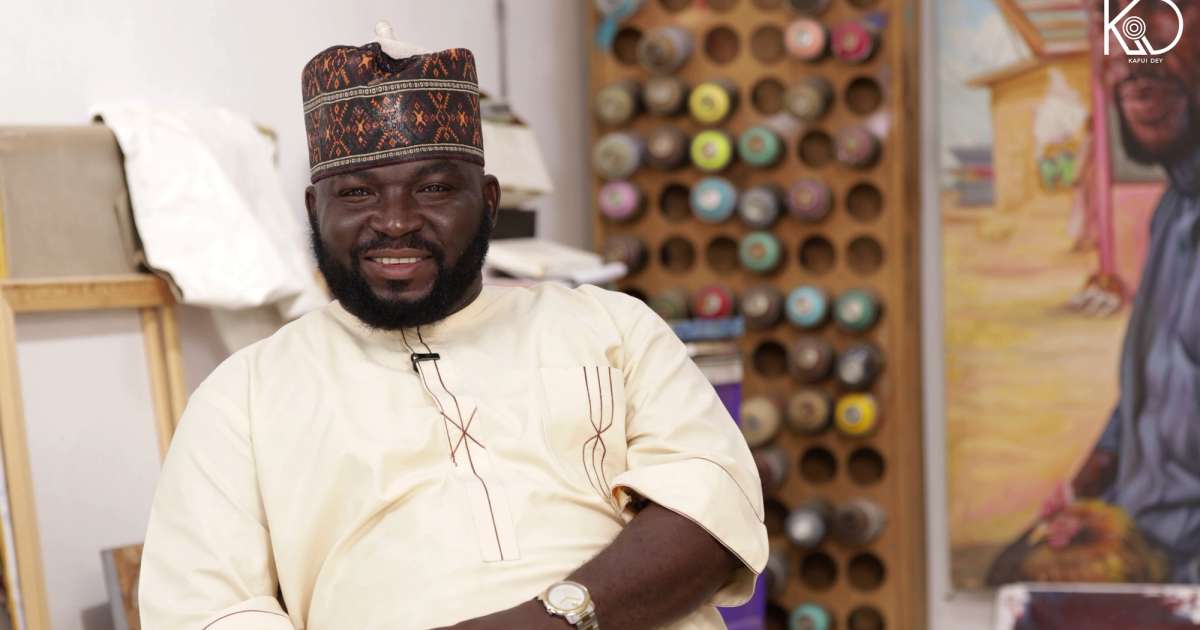
Before the world knew him as an artist, before his work began appearing on television screens and before people called to tell his father, “I saw your son on TV,” Moh Awudu was a young boy trying to survive in a difficult environment.
Growing up in a tough community, he saw many young people around him drift into trouble. The streets offered distractions, and for some, a path that ended in crime.
“When you check in the news, you see maybe one or two of them have been shut down. They want to rob,” he recalled. “It was a rough life.”
For Moh, the streets could easily have become his reality. But at a young age, he found something that gave him a different direction — art.
“Arts saved me,” he said.
At just 11 years old, Moh made the difficult decision to leave home. It was a turning point in the life of a young boy who was searching for a place where he could belong.
His childhood had already carried moments of pain. His mother, who sold koko to support the family, had passed away. His father, a banker, remained one of his biggest supporters.
By the time his mother died in 2012, Moh said he was already old enough to understand life differently.
“My dad was somebody who was always proud of me because he sees me on TV all the time or somebody calls, ‘I saw your son on TV,’” he said.
But before the recognition came, there was a father who noticed his son’s passion and chose to nurture it.
When Moh told his father he wanted to learn art, his father did not dismiss the dream as something unrealistic. Instead, he supported him.
His father returned from leave and bought him painting brushes and materials.
At only 13 or 14 years old, those simple tools became more than art supplies. They became an escape route.
“Now I have a place that I can just go and feel okay and be myself,” Moh said.
The young artist spent hours developing his craft. While other children were focused on ordinary school activities, Moh was already pushing himself beyond his age.
He would spend time in the studio, sometimes sleeping on a bench as he learned and practised.
Before reaching junior high school, he was already producing advanced works for older students.
“I was in class five, primary five, but doing those advanced stuff,” he recalled.
His hunger to learn pushed him to unusual lengths. When his friends attended classes at Gata Arts College on Saturdays, Moh found a way to learn from them. He would follow their progress, copy their notes and study what they were being taught.
“I have a book. It’s like I’m going to the school bus, but when they come back from school, I check their homework, then I copy it. I read everything,” he said.
By the time he eventually applied to study art formally, his skills surprised his teachers.
“They saw my paperwork and said, ‘You already know everything we are teaching here,’” he recalled.
Instead of starting from the beginning, he was advised to join an advanced level and complete a shorter programme. Within months, he was not only learning but also teaching others at the same school.
His journey, however, was not without hardship.
Looking back at those years, Moh remembers the struggles behind the dream.
“You see me with my shoe. If you see the shoe, it’s not easy,” he said.
But the challenges did not stop him. Art had given him identity, purpose and a place away from the pressures of the streets.
In a community where many young people were searching for survival, Moh found a different path. The same streets that threatened to define his future became the place he escaped from through creativity.
For him, art was not just a talent. It was a lifeline.“It saved me,” he said.