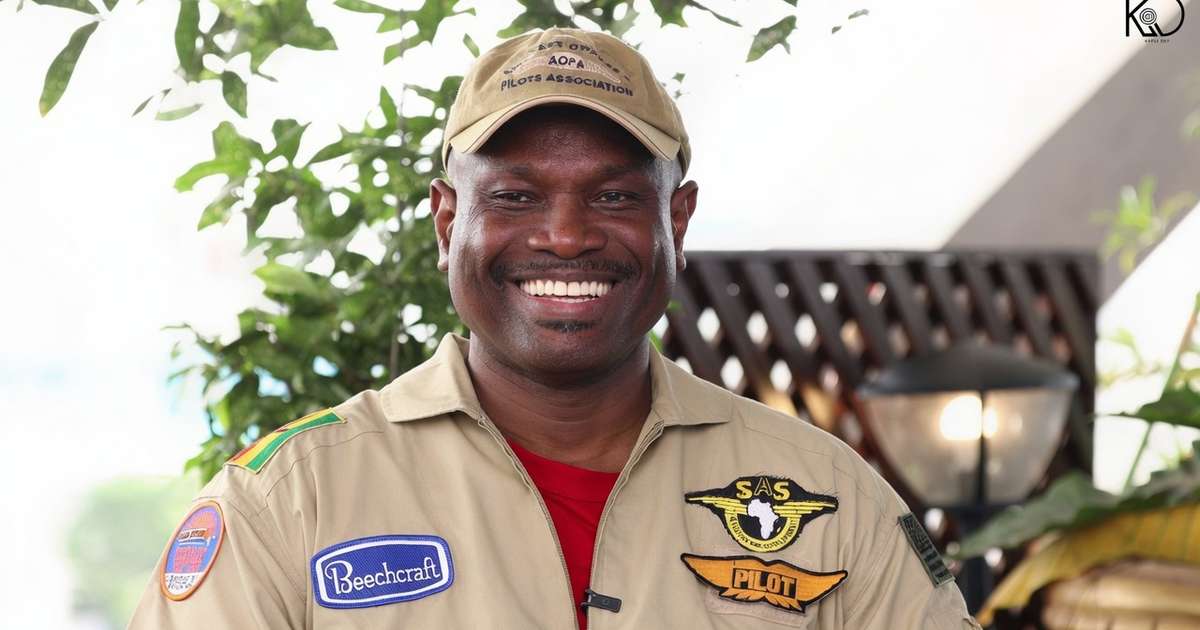
For most passengers, turbulence is an uncomfortable part of flying. A few frightening seconds of shaking before the aircraft returns to calm skies. But for Captain Asiwome Dzakuma, one flight through severe weather was a moment when the thin line between life and death became painfully clear.
The United Airlines pilot recalls that experience as one of the closest calls of his aviation career. A flight where poor weather, limited fuel options and a difficult decision combined to create a situation he still remembers years later.
“I tell people I’ve died a few times over,” Captain Dzakuma said during an interview with Kafui Dey. “But there’s one that actually got me. I look back and I’m like, I really missed death by inches.”
The incident happened in 2004, early in his flying career when he was working with CityLink and the airline had just started operations to Kumasi.
At the time, fuel availability for the aircraft in Kumasi was a challenge, meaning flights had to carry enough fuel from Accra to complete the return journey. The pilots also had to carefully consider weather conditions because they needed enough fuel to return safely if landing conditions became unsuitable.
On that particular day, the crew was preparing to return from Kumasi to Accra. However, they struggled to obtain weather updates before departure.
“We couldn’t get weather,” Captain Dzakuma recalled. “This was back in ’04 from Accra. So, we decided to leave Kumasi.”
As the aircraft approached Accra, the crew eventually received weather information indicating that conditions were expected to deteriorate shortly after their scheduled arrival time.
Dzakuma immediately became concerned.
“My first reaction was, ‘Len, are we good going?’” he said, referring to the captain. However, the captain, a newly assigned South African pilot, decided they should continue the approach.
Instead of taking a shorter route, the captain chose a longer instrument approach procedure known as a DME arc, which guides aircraft through areas with high terrain before gradually bringing them down for landing.
Dzakuma knew another option was available, a more direct route into Accra that could have reduced the flight time and helped preserve fuel.
“I knew we could do direct to Accra , which would have cut the route a bit short,” he explained. “But he was insistent, ‘Oh, we have weather.’”
Then they entered the storm. The aircraft was suddenly thrown into intense turbulence, forcing Dzakuma into a heightened state of alert.
“We got into the weather, coming in, we were bouncing up and down,” he recalled.
As the aircraft struggled through the conditions, Dzakuma focused on supporting the captain from the cockpit.
“I was just on the captain — ‘Hey, down, down, down. Go down. Watch your speed. Watch your speed,’” he said.
At that moment, he realised he was not simply observing the situation as a co-pilot, his own life was also on the line.
“I just realised at that point, hey, my life was also at stake. So, I had to breathe it.”
After what felt like an eternity, the aircraft finally touched down in Accra.
“Eventually, we touched down. Bam. Hard touchdown,” he said.
The relief was immediate, but the passengers had experienced the frightening reality of the approach.
Inside the cabin, panic had taken over.
“They were yelling out. Jesus was flowing all over the place,” Dzakuma said. “Everybody was chanting.”
Among those on board was a senior government official who confronted the pilots after landing, upset about the frightening experience.
“He came up to us and he was like, ‘You didn’t tell us you were going to go through this,’” Dzakuma recalled.
But unknown to the passengers, the real battle had happened inside the cockpit.
Shortly after landing, Dzakuma received a call from his mentor, Captain Richard Ayegbe, who was then an Air Force officer.
“He called and said, ‘Asi, where are you?’ I said, ‘We landed.’ He said, ‘Hey, so you were the one who was going through this weather like that?’”
Ayegbe and others at the station had watched the aircraft’s difficult approach from the ground.
“They were watching us on approach,” Dzakuma said. “They saw, they heard maybe on the radio an aircraft coming, so they were like, ‘Wow, who is this coming in?’”
The experience became a defining lesson in his career, one that shaped how he approached cockpit decisions.
For Dzakuma, the biggest lesson was the importance of assertiveness, especially for junior pilots.
“That taught me to be assertive,” he said. “You cannot, as a pilot, even as a co-pilot, just sit down and let the captain make decisions.”
He explained that aviation requires every crew member to speak up when safety is at risk.
“You have to be strong and stand up and say, ‘No, I can’t, we can’t do this.’ You have to insist because your life is also at stake.”
Since that near-disaster, Captain Dzakuma says he has challenged decisions when necessary, even when facing more senior pilots.
“I’ve turned down captains’ decisions, stood against,” he revealed.
For him, the cockpit is not a place where hierarchy should silence safety concerns. Sometimes, the voice of the junior pilot may be the one that prevents tragedy.