The aircraft was shaking violently. The weather ahead was deteriorating. Passengers in the cabin were crying out for help, calling on God as turbulence tossed the plane through the skies.
But inside the cockpit, Captain Asiwome Dzakuma had no choice but to remain calm.
While everyone else on board was confronting fear, he had a responsibility that came before his own emotions — to make decisions that would get everyone safely back on the ground.
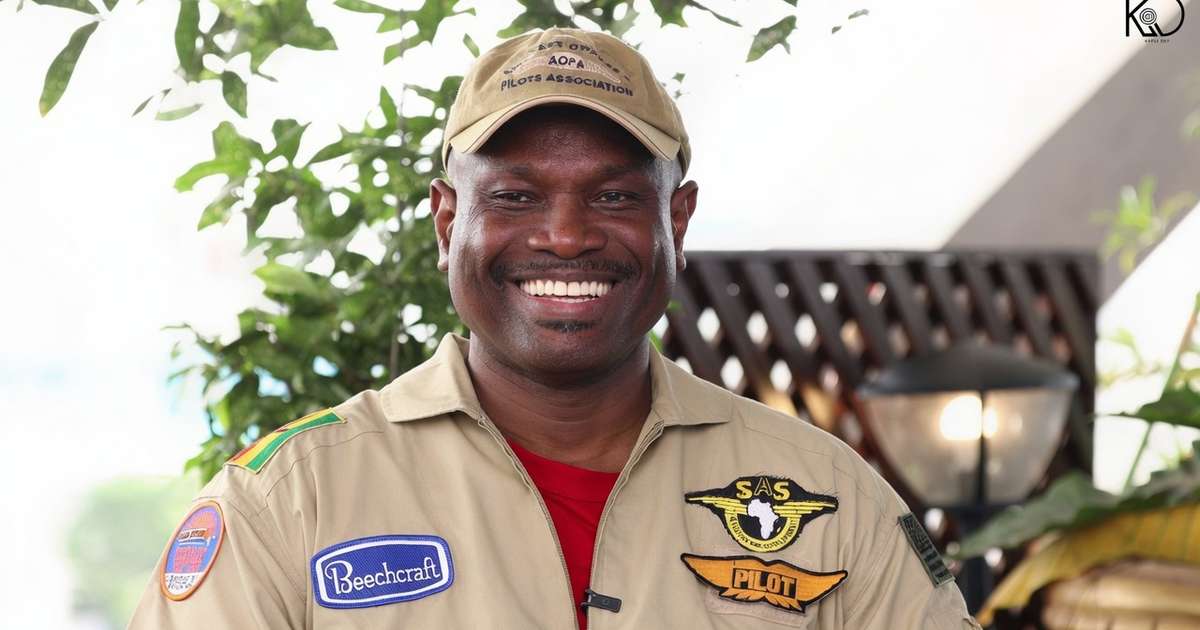
Looking back, the United Airlines pilot describes the experience as one of the moments when he truly felt he had “missed death by inches.”
“I tell people I’ve died a few times over,” Captain Dzakuma said. “There’s one that actually, I thought, I look back and I’m like, I really missed death by inches.”
The incident happened early in his aviation career when he was flying for CityLink, shortly after the airline had started operations between Accra and Kumasi.
At the time, there was no jet fuel available in Kumasi, meaning aircraft had to carry enough fuel from Accra for the return journey, including reserve fuel.
On one particular day in 2004, after completing a flight to Kumasi, the crew prepared to return to Accra. As they began their journey back, they requested weather updates from air traffic control.
But there was a problem.
“We couldn’t get weather,” he recalled.
Eventually, halfway through the flight, they made contact with Accra and received an update: bad weather was expected to arrive at the airport shortly after their estimated landing time.
Dzakuma, who was the co-pilot at the time, immediately began questioning whether continuing was the safest decision.
“My first reaction was, ‘Len, are we good going?’” he recalled.
However, the captain, a newly assigned South African pilot, decided they should continue with the approach.
The aircraft was directed to follow a longer instrument procedure known as a DME arc approach, a route designed to guide aircraft safely around high terrain before descending into the airport.
But Dzakuma knew there was another option.
“I knew the terrain. I knew we could do direct to Accra, which would have cut the route a bit short,” he explained.
The longer route meant spending more time in an uncertain weather system, while fuel remained a consideration.
Then the aircraft entered the storm.
“That day, man,” he said.
The turbulence became intense.
“We got into the weather coming in. We were bouncing up and down,” Dzakuma recalled.
Inside the cockpit, he focused on the aircraft’s speed, altitude and the actions of the captain.
“I was just on the captain: ‘Hey, down, down, down. Go down. Watch your speed. Watch your speed,’” he said.
At that moment, the reality of the situation hit him.
“My life was also at stake. So I had to breathe it.”
Meanwhile, the passengers in the cabin were experiencing the same terrifying conditions from a different perspective.
“They were yelling out. Jesus was flowing all over the place,” he said.
Passengers began praying and calling on God as the aircraft battled through the rough weather.
After what felt like an eternity, the aircraft finally reached the runway.
The landing was far from smooth.
“We touched down. Bam. Hard touchdown,” Dzakuma recalled.
The aircraft eventually pulled off safely, but the tension inside the cockpit remained.
“You should see the South African guy. His face was all red,” he said.
For those on board, the experience had been frightening. After landing, one passenger — a prominent politician who had also served as South Africa’s ambassador — approached the crew with frustration.
“He came up to us and said, ‘You didn’t tell us you were going to go through this,’” Dzakuma recalled.
But passengers did not know what was happening behind the cockpit door — the difficult decisions, the weather assessments and the pressure on the pilots to get everyone home safely.
Shortly after landing, Dzakuma received a call from his mentor, Captain Richard Ayegbe, who was an Air Force officer at the time.
“He said, ‘Asi, where are you?’ I said, ‘We landed.’ He said, ‘So you were the one who was going through this weather?’”
Captain Ayegbe and others had been watching the aircraft’s approach from the ground.
“They were watching us on approach,” Dzakuma said.
The experience left him with one of the most important lessons of his aviation career: the importance of speaking up.
“For me, that taught me to be assertive,” he said.
He explained that pilots, regardless of their position in the cockpit, must be willing to challenge decisions when safety is at risk.
“You cannot just sit down and let the captain make decisions. Your life is also at stake.”
Since that frightening flight, Dzakuma says he has challenged decisions when necessary, even when it meant disagreeing with senior pilots.
“You just have to be strong and stand up and say, ‘No, I can’t. We can’t do this,’” he said.
For the passengers who cried “Jesus!” that day, the flight was a terrifying encounter with nature’s power.
For Captain Dzakuma, it became a defining moment — a reminder that behind every safe landing is not just technical skill, but courage, responsibility and the willingness to speak up when lives depend on it.