There was no warning. No hiss of gas, no sense that anything was wrong. Pierre Kuma had just turned on the stove in his kitchen, walked away to answer a phone call in the hallway, and come back to a closed door.
He opened it.
"I just saw fire come at me," he recalls. "The blue flame with a bit of orange around it, and I heard the sound — voom."
That single moment — August 11, 2020, a Tuesday, somewhere between 12 and 1 p.m. — split Pierre Kuma's life into a before and an after. What followed was 140-plus days in hospital, six weeks in intensive care, four weeks on a ventilator, four surgeries, twelve blood transfusions, and a 39% total body surface burn. It's also, six years later, a story he tells with something close to gratitude.
The Morning Nothing Seemed Unusual
Pierre was a project engineer working a hybrid schedule during the pandemic, deep in negotiations for a subsea construction contract. That Tuesday morning was ordinary in every way — coffee, work on a technical deck layout, a text exchange with a friend about meeting up later, a mental note to pray for thirty minutes in the afternoon, as he did most working days.
Sometime after his prayer, he went into the kitchen to heat up okra stew his mother had given him over the weekend. He lit the gas stove — clean blue flame, nothing wrong — and then his phone rang in the hallway. He left the kitchen to take the call, closing the door behind him without thinking about it.
When he came back and opened that door, a wall of fire met him.
The Memory That Isn't There
What happened in the next several seconds is something Pierre has never been able to recover — not through therapy, not through time, not through anyone describing it to him.
"Between seeing it and whatever got me to the floor, I have no memory of it," he says. "I've never had any memory of what happened in between there. So what I have recorded... is voom, and then I'm getting up. I don't know how I got to the floor."
There was no pain in that moment either — no sensation at all beyond the flash of blue-orange flame and, seconds or minutes later, finding himself upright and walking, almost on reflex, out of the kitchen and out of his building.
He found his neighbor, Rita. "Are you okay?" she asked. His response, astonishingly calm, was that he thought he should go to the hospital — purely as a precaution. He still didn't know he was burned. It wasn't until he reached his own gate, put his hand on the lock, and saw the skin on the back of his palm peeling away that the reality began to land.
The Drive to the Hospital
What followed reads like something out of a film. Neighbors jumped walls to help him. He was driven first to a private hospital, where a doctor noticed something alarming: there was no hair left inside his nose — a sign he'd inhaled superheated air and gas, putting him at risk of his airway swelling shut. He was rushed by ambulance to Korle Bu Teaching Hospital's burns unit.
And through all of it, Pierre was singing.
In the car, in the ambulance, in the emergency room — he sang worship songs, prayed out loud, and even, strangely, found himself recounting the story of William Tyndale, the 16th-century priest burned alive for translating the Bible. He gave his neighbor his phone password so she could call his mentor, his colleague, and his boss in Norway. He gave directions to the hospital because he was the only one in the car who knew the way.
By nightfall, doctors had detected the inhalation injury was severe enough to require intubation — tubes to hold his airway open and a ventilator to breathe for him. He was wheeled into surgery. The last thing he remembers before waking up in intensive care is asking the people around him to pray with him.
Six Weeks in the ICU
Pierre would spend the next six weeks in intensive care, on and off a ventilator for roughly four weeks total, undergoing skin grafts harvested from the only parts of his body the fire hadn't reached — his thighs, protected by the shorts he'd been wearing.
The scale of what his body went through is hard to grasp. Burns of that severity don't just damage skin — they send the entire body into shock, disrupting internal organs and even bone marrow function, which is part of why Pierre needed twelve separate blood transfusions during his recovery. At one point, a transfusion reaction broke out in rashes across his back mid-transfusion, forcing doctors to stop and reassess.
There were nights his medical team feared they had lost him. One in particular — a Monday, early morning — he remembers struggling to breathe so severely that, in his own words, he mentally made peace with the idea that this might be the end.
He survived. He doesn't remember why.
What he does remember: relearning to sit up in bed. Relearning to swing his legs to the side. The first time he stood, supported by a physiotherapist and nurses, only to look down and see blood seeping through his bandages as circulation rushed back into limbs that had been still for weeks. He collapsed more than once — once simply trying to stand up from using the bathroom, another time on an early-morning hospital walk, tired, leaning against a wall, and waking up flat on the floor.
"These were billion-dollar projects for me," he says of learning to sit up, get his legs to the floor, stand. Tasks that used to be nothing had become the hardest work of his life.
The Moment Gratitude Arrived
Pierre pinpoints a specific turning point in his recovery — not physical, but mental.
After leaving the ICU for the main ward, he began noticing something: of the people who had been in intensive care alongside him, most hadn't made it out. A three-year-old boy with what seemed like a minor burn had died from complications. Person after person he'd shared that unit with had passed away.
"It occurred to me that... it's not normal to really walk out of the ICU alive," he says. "The normal thing is you get out and go to the mortuary — not get out and go to another ward, or even go home."
Lying in bed with both arms in casts, unable even to hold a bottle to water himself, he made a decision. "God, I thank you for that. I'm still alive. Forgive me for all my complaints."
From that point on, the first time he saw his own reflection, the first time he saw his hand reduced to half its normal size from weight loss, none of it broke him the way it might have. He'd already reframed the entire experience around one fact: he was alive, and very nearly wasn't.
Learning to Live Again
Recovery was not linear. Pierre describes the wound-dressing sessions — three times a week, Mondays, Wednesdays, and Fridays, like clockwork he came to know by heart — as some of the most physically brutal moments of the entire ordeal. Gauze fused to raw skin by dried body fluid, peeled away layer by layer. Staples used to hold skin grafts in place, removed weeks later without anesthesia because general anesthesia itself carries real risk and can't be used repeatedly.
He was discharged on December 31, 2020 — the very last day of the year. He didn't return to gas cookers. He didn't fully shower standing up again until June 2022, nearly two years after the accident. He didn't wear a full shoe again until an April 2022 wedding.
Each of these — showering standing up, wearing real shoes, easing back into work with a single low-stakes budget request — became its own quiet victory. "It's great to be back," he remembers telling colleagues, feeling, for the first time in months, useful again.
What the Fire Left Behind
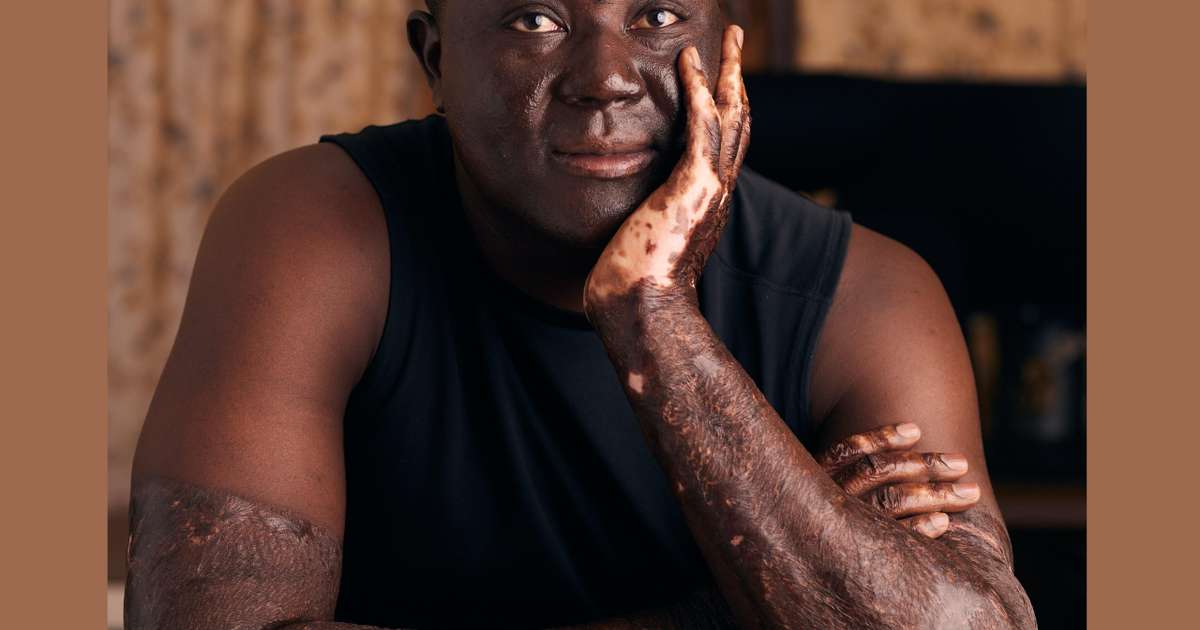
Today, Pierre carries visible scars — patches where skin grafts didn't fully take, skin tone that shifted from burn trauma before slowly repigmenting over roughly two years. Strangers still stare. Children sometimes react with visible shock, which is part of why he now sometimes wears compression sleeves in public — not for himself, he says, but so as not to leave a lasting impression on a child who might carry the image with them.
But ask him about regret, and the answer is immediate and unflinching.
"I actually don't have any regrets in this experience," he says. "I'm glad I got burnt. I'm glad I went through the fire."
It's not a sentiment he pretends would have made sense in the moment. It's one that only became true on the other side of it — a conviction that shapes how he now talks to anyone facing their own version of the fire, whatever form it takes.
"That struggle you are going through is temporary. It's not permanent. It will end," he says. "The same God that took me through can take you through."
Pierre has since written a memoir about the experience, The Stench of Good News, and now works as a certified professional coach, using the story — and the stories of other survivors he interviews — to help people find their way through their own lowest moments.
This is the first in a series exploring Pierre Kuma's story — from life on offshore oil rigs to his transformation into a coach and author. Read more from the full conversation on our site.