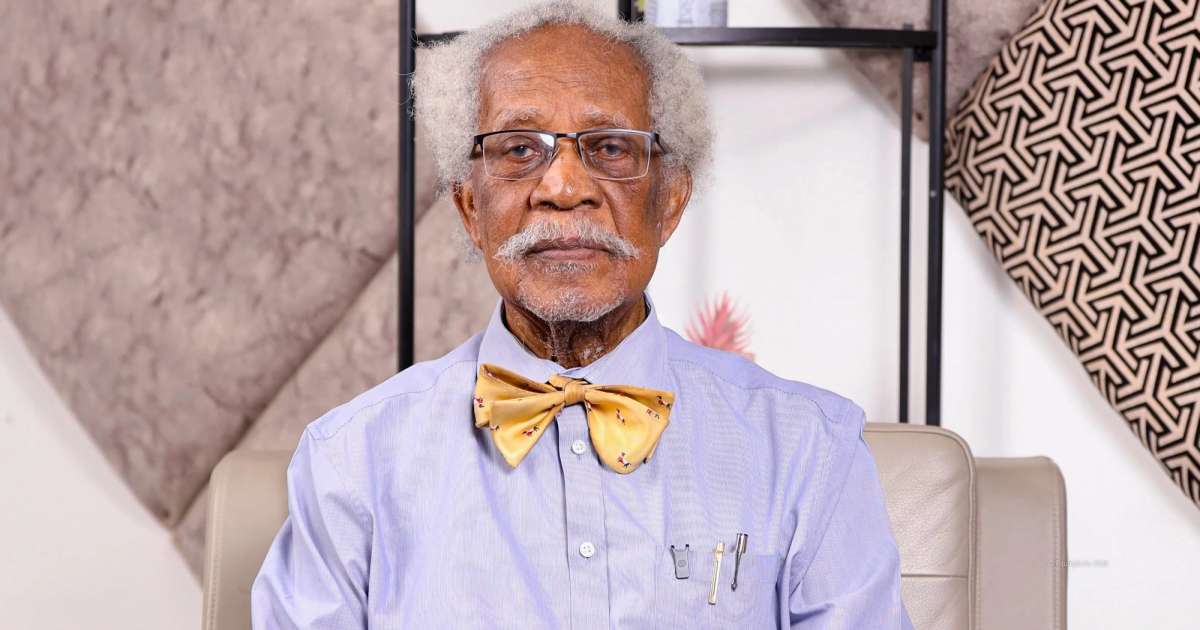
On 6 March 1957, while thousands gathered in Accra to witness the birth of a new nation, a young medical student named Bernhardt Ago Sowa Kuma was more than 5,000 kilometres away in Britain.
He could not stand in the crowd at the Old Polo Grounds to hear Kwame Nkrumah declare that “the Black man is capable of managing his own affairs.” Instead, he followed Ghana’s march to independence from afar, reading newspaper reports and waiting for news from home.
“It was my birthday,” Mr. Kuma says with a smile. Born on 6 March, Ghana’s Independence Day would forever become a double celebration in his life.
Yet independence changed far more than the date on the calendar.
It changed who he was on paper.
When Professor Kuma first travelled to Britain in 1955 to study medicine, he did not leave as a Ghanaian.
He left as a British subject.
“I’ve still got my old passports,” he tells Kafui Dey. “About five of them.”
The very first one tells the story of a country that no longer exists.
“The first one I had… was a British passport.”
Kafui Dey pauses in surprise.
“You had a British passport because you were a British citizen?”
“Yeah, of course,” Mr. Kuma replies matter-of-factly.
Like many people born in the Gold Coast before independence, his legal identity was tied to Britain’s colonial rule. When he arrived in the United Kingdom, he did so not as a foreign student, but as a citizen of the British Empire.
Then history intervened.
On 6 March 1957, the Gold Coast became Ghana.
The colony disappeared.
A nation was born.
When Professor Kuma eventually completed his studies and prepared to return home, his documents had to change too.
“I had it renewed at the Ghana High Commission ,” he says. “And they gave me a Ghana passport.”
It was more than an administrative process. It marked the transformation of a young man whose homeland had claimed its own identity while he was abroad.
Mr. Kuma left the Gold Coast carrying a British passport.
He returned to an independent Ghana carrying a Ghanaian one.
His old passports remain carefully preserved to this day, not as souvenirs, but as pieces of living history.
“They’re for the records,” he says.
Mr. Kuma first travelled to Britain in 1955 and returned home in 1963 after completing his medical education and housemanship. During those eight years, the country he had left behind was transformed forever.
His journey mirrored Ghana’s own.
He departed as the subject of an empire.
He came home as the citizen of a nation.