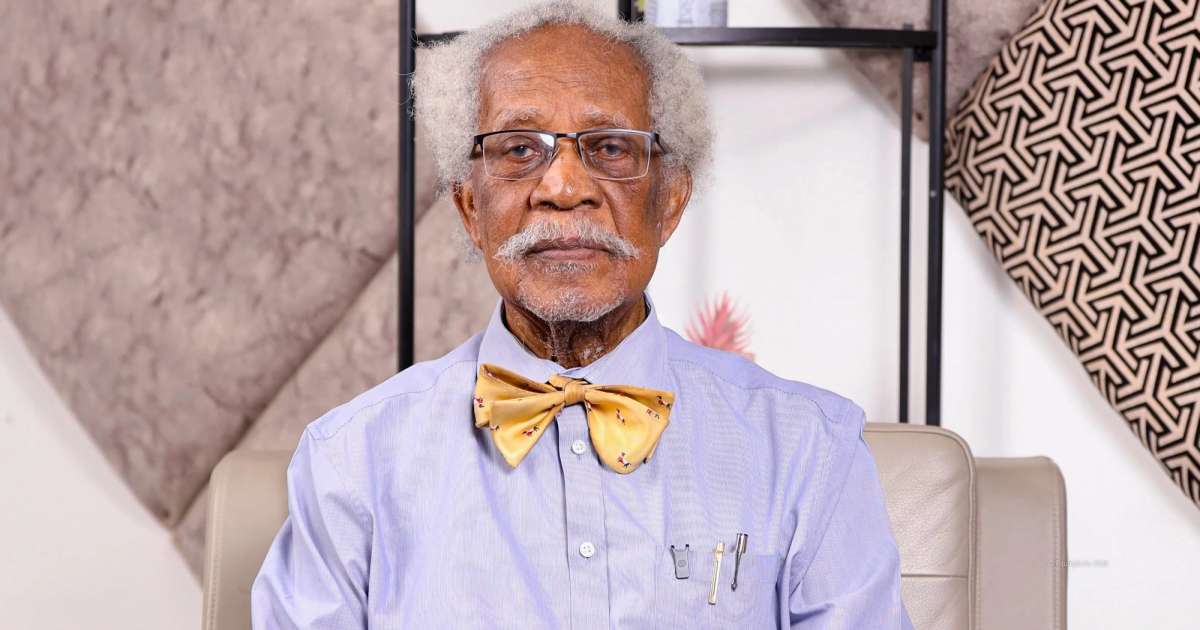
Orthopaedic Surgeon, Mr. Bernhardt Ago Sowa Kuma still remembers the day he boarded an airplane for the very first time.
Leaving the Gold Coast for Britain to study medicine was a life-changing moment, but unlike many who travelled overseas during the colonial era, he says fear was never part of the journey.
“I didn’t mind,” he says with a smile when Kafui Dey asks what it felt like to board his first flight.
The journey was not direct. The aircraft stopped in Casablanca, Morocco, before continuing to London. From there, he made his way to Bristol, one of Britain’s oldest cities and one whose history was deeply intertwined with the transatlantic slave trade.
“It was one of the major slave trade centres,” Mr. Kuma says.
Even the city’s landmarks seemed to echo that history.
“There was White Ladies Road… Black Boy Hill,” he recalls, noting that his student residence stood near the famous hill.
The names stayed with him, but it was not street signs that would leave the deepest impression. It was the subtle ways race shaped everyday life.
Asked whether he experienced culture shock, he simply replies, “No.”
But when asked if he ever felt discriminated against, his answer is immediate.
“Yes, you could feel it.”
One incident remains vivid.
Medical students were required to dissect parts of the human body and invite lecturers to assess their work. Professor Kuma and his colleagues repeatedly called on one particular instructor to evaluate them.
“We invited one teacher on three occasions,” he recalls. “At the end of the third visit, the other students said, ‘Have you something against this teacher? You’ve been the best in the past and yet he’s given us the same mark.’”
The concern did not come from the African students. It came from his classmates, who had noticed that something did not seem right.
Professor Kuma never protested.
“No,” he says quietly. “No.”
Years later, while pursuing postgraduate studies in Britain, another encounter would test him again.
An examiner presented him with a scenario involving surgery in a remote African community with limited medical resources.
“I said I’d use litmus paper,” Mr. Kuma recalls.
The examiner dismissed the answer.
“He said, ‘No, use specific gravity.’”
Young Kuma knew the criticism was misplaced. The two methods were different, and the suggested alternative was not as readily available as the examiner implied.
By the end of the oral examination, his frustration was visible.
“The examiner asked me, ‘Are you angry?’ I said, ‘No, I’m not angry with you, but I’m upset.’”
Then something unexpected happened.
Another examiner, who had been quietly observing the exchange, turned to his colleague and challenged him directly.
“What have you got against this man?” he asked. “Is it because he’s a Black man? He speaks English even better than you do.”
For Mr. Kuma , it was a rare moment when someone inside the system acknowledged what he had experienced.
Rather than allowing prejudice to define his career, he chose to let excellence speak for him.
When he returned to West Africa, he was invited in 1979 to become an examiner for the West African College of Surgeons in Ibadan, Nigeria a role he would hold for an extraordinary 40 years.
“My last trip was in 2019,” he says.
During one examination in the early 1980s, a visiting British observer came to watch the process. After seeing how the examinations were conducted, the visitor addressed the panel of examiners.
“Ladies and gentlemen,” he said, “you’re doing a wonderful job. We in England haven’t got to where you are.”
For Mr. Kuma, the compliment carried special meaning.
The young African student whose abilities had once been questioned in Britain had gone on to help shape generations of surgeons across West Africa. The man who quietly endured discrimination eventually became one of the region’s most respected medical examiners.
His story is not one of bitterness. It is one of perseverance.
Racism tried to place limits on what others believed he could achieve. Professor Bernhardt Ago Sowa Kuma answered not with protests or resentment, but with decades of excellence that ultimately earned the respect of even those from the very system that had once underestimated him.