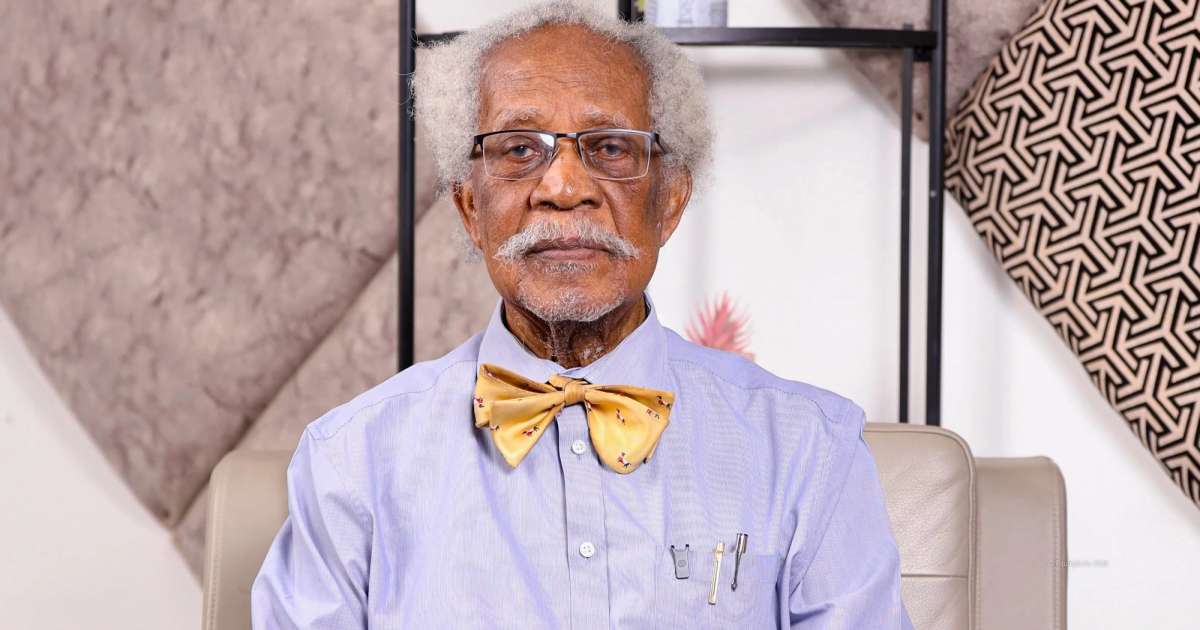
For seven years, while many of his colleagues sought better opportunities abroad, Professor Ago Kuma Sowa walked through the gates of Korle Bu Teaching Hospital every morning before 7:00 a.m., carrying a responsibility that few doctors would ever face.
He was the hospital’s only orthopaedic surgeon.
It was a period when Ghana’s healthcare system struggled to hold on to its specialists. Doctors were leaving for the Middle East and other countries in search of better pay and working conditions, leaving behind widening gaps in the nation’s hospitals.
Professor Sowa had planned to join them.
But one conversation at home changed everything.
“I was going to go away for a year,” he recalled during an interview with Kafui Dey. “When I told her, she said, ‘Who’s going to look after me?’ And I never went.”
The “her” was his daughter.
When Kafui Dey remarked, “We credit her for stopping you,” the veteran surgeon smiled and simply replied, “Yes.”
That decision would shape the lives of thousands of patients and generations of Ghanaian doctors.
For the next seven years, Professor Sowa shouldered the entire orthopaedic workload at Korle Bu Teaching Hospital. Every day followed the same disciplined routine.
“Before 7:00 I was there,” he said.
His mornings always began with a walk through the Accident Centre, assessing new trauma cases before moving from one patient to another. Despite the enormous responsibility, he never described those years as a burden.
“The work has to be done,” he said matter-of-factly.
Asked whether he ever felt overwhelmed by being the only orthopaedic surgeon at the country’s premier teaching hospital, his answer was immediate.
“No, I didn’t.”
Instead of dwelling on hardship, Professor Sowa pointed to the larger issue that was driving specialists away. Doctors, he argued, were not leaving because they lacked commitment to Ghana but because other countries offered stronger incentives.
“If you go to the United States and you are qualified to work there,” he explained, “you have certain privileges… insurance-wise, to be able to buy a house at a cheap rate, to buy a car.”
He spoke of younger doctors whose families had already settled abroad, illustrating how migration often became a permanent decision rather than a temporary one.
His concern extended beyond doctors to the country’s health infrastructure itself. Despite Accra’s rapid population growth, he noted that the Greater Accra Region had seen little expansion in major public hospital infrastructure over decades.
“As I keep saying,” he observed, “LeKMA Hospital is the only hospital in the Greater Accra Region which has been built within the past 50 years.”
Looking back, Professor Sowa’s story is not simply about professional endurance. It is about quiet sacrifice, a surgeon who chose duty over opportunity because of a daughter’s simple appeal, then reported for work before sunrise every day without complaint.
When asked how he managed to carry such a weight alone, he offered no dramatic explanation.
Only a philosophy that defined his career:
“If the work has to be done, it has got to be done”.