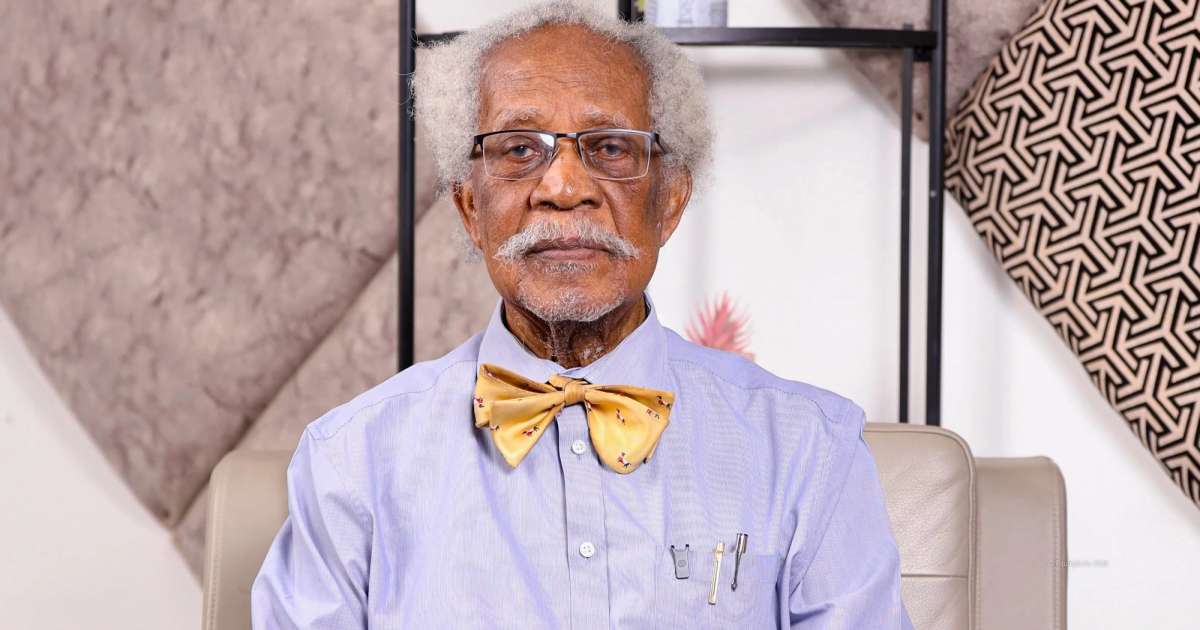
At 94, Professor Bernhardt Ago Sowa Kuma has outlived most of his contemporaries, trained generations of doctors, and watched medicine evolve over more than six decades. Yet, when asked what it feels like to be 94, his response is as honest as it is disarming.
“I have never been 94 before,” he said with a smile during an interview with Kafui Dey.
The answer perfectly captures the man many regard as the father of orthopaedic surgery in Ghana; humble, thoughtful and quietly humorous.
Time, he admits, has changed his body.
“I’m not as active as I used to be,” he said.
Rather than speaking in generalities, the veteran surgeon explained ageing the way only an orthopaedic specialist could. He described how, after about the age of 30, the body’s balance between calcium being deposited into bones and being reabsorbed begins to shift. As the spine ages, spaces through which nerves pass become narrower, leading to pain and discomfort in the neck, arms and legs.
For a man who was once an accomplished athlete in school, the changes have not been easy.
“It’s annoying,” he admitted without any bitterness in his voice when Kafui Dey remarked that slowing down must be frustrating for someone who had once been so swift on his feet.
Asked whether he is happy at 94, Professor Kuma paused before offering a simple answer.
“I cannot complain.”
Perhaps what keeps him young is that retirement has never truly appealed to him.
While many people his age have long withdrawn from professional life, Professor Kuma still spends his days where he has always felt most at home—the medical school.
“My typical day,” he explained, “is imparting knowledge to undergraduates and postgraduates.”
He is still teaching.
The classroom remains his operating theatre, where experience is passed from one generation to the next.
Teaching, however, has changed over the decades. Looking back on students he taught half a century ago, Professor Kuma believes the difference is not necessarily intelligence.
“I wouldn’t say they were brighter than these ones,” he reflected. “But they were more attentive.”
He quickly added that circumstances have changed dramatically. Fifty years ago, classes were much smaller, making it easier for lecturers to engage students individually.
“Let’s say about three or four ,” he recalled of the typical class size in those days.
Today, those numbers have more than doubled or even tripled.
“It’s a lot more work for the teacher,” he observed.
His commitment to teaching has not gone unnoticed. In 1989, medical students voted him Best Teacher of the Year, an honour that remains one of the many milestones in a distinguished career.
The recognition reflected the same discipline that defined his clinical practice. During the years he served as the only orthopaedic surgeon at Korle Bu Teaching Hospital, he arrived at work before 7 a.m. every day, determined that no patient would go unattended.
Now, at 94, Professor Kuma no longer races through hospital corridors as he once did. Age has slowed his steps, but it has not diminished his purpose.
For a man who has spent a lifetime healing broken bones, perhaps his greatest legacy is not found in the operating theatre at all. It lives in the thousands of doctors who continue to carry forward the lessons of the teacher they once voted their best.
@PK